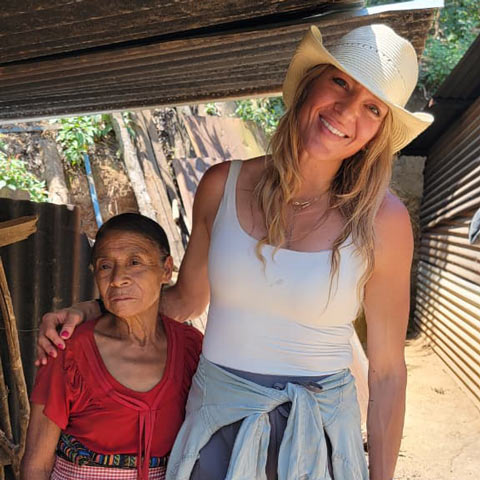
Redefining Relief: How an MSDP Alumna is Rewriting the Narrative of Global Development
For many professionals in the nonprofit sector, passion is the starting point. But for Heidi Johnson, a 2022 graduate of Regis University’s Master’s in Sustainable Development Practice (MSDP) program, passion without formal, critical training can be a liability.
"I’ve seen global development work done well, and I’ve seen it done not well," says Johnson, who currently serves as the Associate Director of Marketing and Development at Healing Waters International. "There is a common hubris where people think that because they have funding or a passion, they are equipped to do this work. But you don’t know what you don’t know. If you enter this space without formal training, you run the risk of being well-intentioned but doing real harm."
Today, Johnson uses her Regis education to navigate the complex intersection of global marketing, fundraising and community-led development — ensuring that the stories told to donors preserve the dignity of the communities being served.
The Journey of "Unlearning"
When Johnson first discovered the MSDP program (then called the Master's in Development Practice, or MDP), she was already deeply embedded in the international sector. Working as an executive director for a small organization, she managed global teams operating neonatal health services in Sub-Saharan Africa and support programs for youth in South and Southeast Asia.
Looking to deepen her impact, she applied for a highly competitive one-year scholarship offered through Denver’s Posner Center for International Development. She won the scholarship, completed her first year fully funded and quickly realized the curriculum was too valuable to stop at a certificate. Her employer agreed, funding half of the remainder of her master’s degree.
Spanning the pre- and post-pandemic eras, Johnson’s time at Regis was defined by a truly global classroom. While local students met in person, classmates from across the globe streamed in digitally. This diverse tapestry of backgrounds — combined with faculty experts operating at the highest levels of international development — forced a profound shift in perspective.
"There was so much unlearning," Johnson recalls. "Coming into a global development space, you carry a particular Western paradigm or cultural upbringing. The MSDP program helped reframe how to approach this work in order to avoid common pitfalls.” She notes how the curriculum made a concerted effort to center global, non-Western resources and indigenous perspectives.
That ideological shift culminated in her master’s thesis: a rigorous, low-resource neonatal health program designed for rural Angola. Far from a purely academic exercise, the program Johnson designed for her thesis is still actively operating today, providing life-saving interventions.
Moving Beyond "Utilitarian" Fundraising
Now at Denver-based Healing Waters International, a nonprofit dedicated to ending the global water crisis, Johnson operates on the front lines of marketing and development. It is a role that requires her to balance the financial realities of fundraising with the ethical framework she honed at Regis.
"In fundraising, it’s easy to create utilitarian narratives — the idea that if we get the funds, it doesn’t matter how we told the story. Regis pushed back hard on that. We learned how to identify and [dismantle] harmful narratives … ensuring we bring dignity and honor to the people we serve."
Johnson actively applies this framework as Healing Waters refines its organizational "Theory of Change" — a strategic process she was able to confidently guide thanks to her technical training at Regis. By combining programmatic expertise with marketing strategy, she helps the organization communicate its unique niche in a crowded global arena.
Tackling the Complexities of Clean Water
The global water crisis is rarely a simple fix, and Healing Waters intentionally targets geographic areas that are often bypassed by standard aid models. "We don't just look for the low-hanging fruit," Johnson explains. "We work with highly marginalized communities that have been pushed into remote, difficult locations due to poverty or war."
To illustrate the diverse technical challenges her organization tackles, Johnson points to three distinct regional examples:
- El Pajal, Guatemala: Located high in the mountains, this coffee-farming community faces severe access barriers. Rather than piping water kilometers up from a river, Healing Waters is partnering with hydrogeologists to tap into deep groundwater wells directly on the mountain.
- Chiapas, Mexico: A region plagued by heavy industrial pollution from mining companies dumping chemicals into water sources. Resolving this crisis requires sophisticated reverse-osmosis purification systems.
- Haiti: Communities here face severe coastal contamination, requiring specialized filtration technology to treat highly brackish water.
True to the decolonizing approach emphasized at Regis, Healing Waters doesn't just install equipment and leave. They train, equip and empower local community members to entirely own and operate the systems themselves, transforming an act of temporary relief into permanent, sustainable infrastructure.
Turning Passion into a Professional Career
For prospective students looking at the Regis MSDP, Johnson emphasizes that the program offers something far greater than technical skills like monitoring, evaluation and participatory planning; it offers professional longevity and mentorship. Long after graduation, Johnson met monthly with faculty mentors to actively troubleshoot real-world leadership challenges in the field.
"This work isn't always easy," Johnson admits. "You deal with compassion fatigue, and you don't always get paid the highest salaries. But intrinsically, it has immense value."
Her advice to the next generation of global change-makers?
"Formal education that is geared towards this work is a must. If you're going to enter this space — especially if the work you're doing is going to impact those in other countries — you need to have some formal training.”