A Different Kind of Learning: What Does It Mean to Be Jesuit Educated?
Imagine graduating with more than a degree. Imagine leaving college with a clearer sense of who you are, what matters to you and how your talents can make a difference in the lives of others.
This is the idea that sits at the heart of Jesuit education.
While students still gain the knowledge and skills needed for successful careers, Jesuit education has always aimed for something more. Students learn to ask difficult questions, reflect on their experiences, understand their responsibilities to others and pursue lives marked by purpose.
This approach has shaped learners and leaders for nearly 500 years. In a culture that often rewards speed, achievement and constant productivity, it offers something valuable: the ability to pause, reflect and choose a path that is both successful and meaningful.
But what does this mean in practice?
Jesuit Education and “Contemplatives in Action”
Jesuit universities prepare students differently, to use their talents, knowledge and influence with integrity. Unlike many traditional college models, Jesuit education integrates academic excellence, personal reflection, leadership development and social responsibility.
This philosophy is perfectly captured by the term “contemplatives in action.” Students are challenged to look beyond personal achievement and consider how their decisions affect others. This commitment to forming “men and women for and with others” means education is about more than preparing for a career — it’s about developing the judgment, compassion and sense of responsibility to use one’s knowledge in service of the common good. Throughout their education, students are encouraged to ask who benefits from their work, who may be left out or underserved and how they can use their talents to make a meaningful difference.
That perspective shapes learning across every discipline. Health care students explore dignity, access and whole-person care. Business students examine ethical leadership and social impact. Technology and computing students consider questions of privacy, accessibility and fairness. Whatever path they pursue, students graduate prepared to lead with intentionality, compassion and ethical responsibility.
What Does "Magis" Mean and Why Is It Important?
One of the most misunderstood concepts in Jesuit education is Magis, a Latin word often translated as "the more." At first glance, it can sound like a call to do, achieve, and produce more. However, in reality, Magis means something much deeper.
Instead of asking “How can I do more?” Magis asks, “What is the greater good, and how can I make the most meaningful contribution?”
The practice of Magis emphasizes discernment — carefully considering how to use your talents in ways that align with your values, thus creating the greatest positive impact. As a direct contrast to a culture focused on performance metrics and career status, Jesuit educated students learn to value:
- Meaning over status
- Purpose over prestige
- Contribution over competition
- Impact over recognition
- Growth over achievement
A Jesuit Education Is for Everyone
A common misconception about Jesuit education is that it is only for Catholic students. In reality, Jesuit universities welcome students of all faith backgrounds or even no faith tradition. The guiding values of Jesuit education are rooted in universal human questions:
- Magis: How can I make my most meaningful contribution?
- Men and Women for and With Others: How can I use my talents to serve others?
- Contemplatives in Action: How do I make thoughtful, equitable decisions?
- Cura Personalis: How do I care for the whole person — myself and others?
- Unity of Heart and Mind: How can intellectual curiosity be guided by compassion, emotional intelligence and moral responsibility?
- Find God (or the good) in all things: How can my education help me find deeper meaning, beauty and connection in unexpected places?
These principles are an integral part of a broader philosophy of values-based education and holistic student development.
Why Jesuit Education Matters Today
In today’s rapidly changing world, Jesuit education is more relevant than ever. As industries evolve and technology like AI reshapes the workforce, employers are looking for more than technical skills. They are seeking graduates who can think critically, navigate complexity, act honorably and lead with purpose.
The true distinction of Jesuit education is not found in a specific curriculum, classroom model or religious requirement. It is found in its vision of what education should accomplish. At institutions like Regis University, this tradition offers something increasingly rare: a commitment to developing not only what you know, but who you become.
The Ignatian Pedagogical Paradigm in Jesuit Education
A key foundation of Jesuit education is the Ignatian Pedagogical Paradigm (IPP), also known as Ignatian pedagogy, an approach that connects learning and reflection in a continuous cycle:
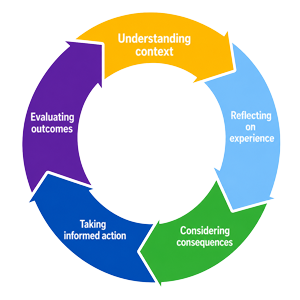
Rather than separating thinking from doing, professors challenge students to integrate reflection and action, developing leadership, ethical decision-making and lifelong learning habits needed to navigate a changing world.