Regis Life
Healing in nature: Regis alumnus publishes book of essays on meditation and discernment
The Jesuit practice of discernment, through the work of a Jesuit education, calls the individual to spend time reflecting on the deeper purposes of decision-making. At Regis University, students, faculty and alumni are practicing discernment in all that they do.
For alumnus Troy Allan, M.A., his education at Regis has led to discerning a fully published book of essays: In the Shadows: Essays on Seeing. Expanding upon his manuscript he created during his time in the Mile-High MFA program, In the Shadows is an exploration into the spaces of self-discovery.
In constant connection with other people, In the Shadows has evolved with the relationships built both at Regis and in Allan’s life after graduation. Graduating in the summer of 2020, Allan was plunged into COVID-19.
Allan slowly added onto his manuscript, writing essay after essay, with the new experiences of the pre- and post-pandemic world from the new ways of connecting with others and with nature. Ultimately, Allan took the plunge, publishing his book, which will be released soon through Tactical 16 Books.
“The real reason is that these essays will do no good sitting on a shelf.” Allan continued, “I believe humans live in stories like fish live in water; we have to have stories.”
Allan is many things: a rancher, professor at Utah State University (USU) and a retired US Army chaplain. His wealth of experiences shapes not just his writing, but the vocations that he pursues every day.
Growing up in rural Utah, Allan has always been connected to ranchers, farmers and rural communities. Five years ago, he and his wife started a sustainable agricultural business in southern Utah, inviting resident artists and folks from around the country to visit. However, both Allan and his wife returned to the education field, leading to his role at USU.
As a clinical chaplain, not just a veteran, Allan had spent much of his military career immersed in the extremes of human experience. Mental health care has been centered in his work through literature and real-world reflection in his educational practice.
“All of a sudden, here we are back again with people just as in-depth as chaplaincy,” said Allan. “I'm continuing to see this, you know, how people are in rural areas and the struggles that they have. But I continue to write; I continue to push the boundaries of how art and mental health come together.”
Allan’s educational and literary style focuses on the strengths of nature in the healing process and in the self-grounding grandeur of nature. Leading both fly-fishing excursions for veterans and “dark skies” experiences for rural teens, Allan constantly heads into the outdoors as a source of healing.
“When I started working with folks down here with their mental health, one of the things I asked was, ‘have you been outside lately?’” Allan continued, “We're going to go out and look at the stars, and we're going to experience this emotion called ‘awe,’ which creates this small self and our worries shrink as well.”
Allan’s constant search for a creative healing outlet led him to Regis University, where he joined the Mile-High MFA program to expand his writing skillset. Allan found in Regis a place where he could not only experience education at his own pace, but a university that reflected his values.
Throughout the four years in which Allan worked on his manuscript, pursuing his degree, he experienced the full breadth of a Jesuit education, where his writing flourished.
“I think that's where we need to be, non-reactive, to slow down, and at Regis, I learned that. That's what these essays are about,” said Allan. “I think the ordinary can be sacred, and I learned that from Regis as well.”
Learn more about Regis’ Mile-High MFA program here.
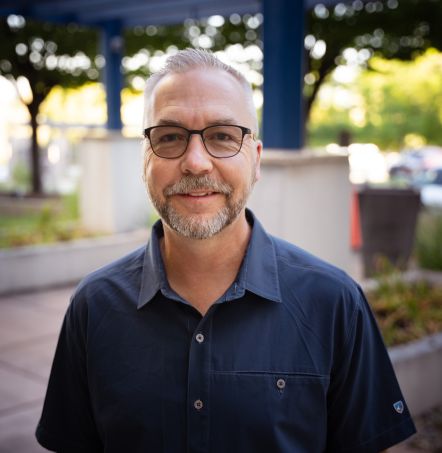
USU professor and author of In the Shadows: Essays on Seeing, Troy Allan.