Regis Life
The Vinyl Revolution: One Regis Professor’s Documentation of a Living Subculture
In 2016, Eric Fretz, Ph.D. professor of Criminology, Sociology and Justice Studies at Regis University, arrived in Timișoara, Romania, for the first of his Fulbright scholarships at the University of the West. Fretz wore his black leather jacket, leading their local guide to ask: “Do you like rock and roll?” Little did he know that this choice would be the beginning of an international friendship and next academic project.
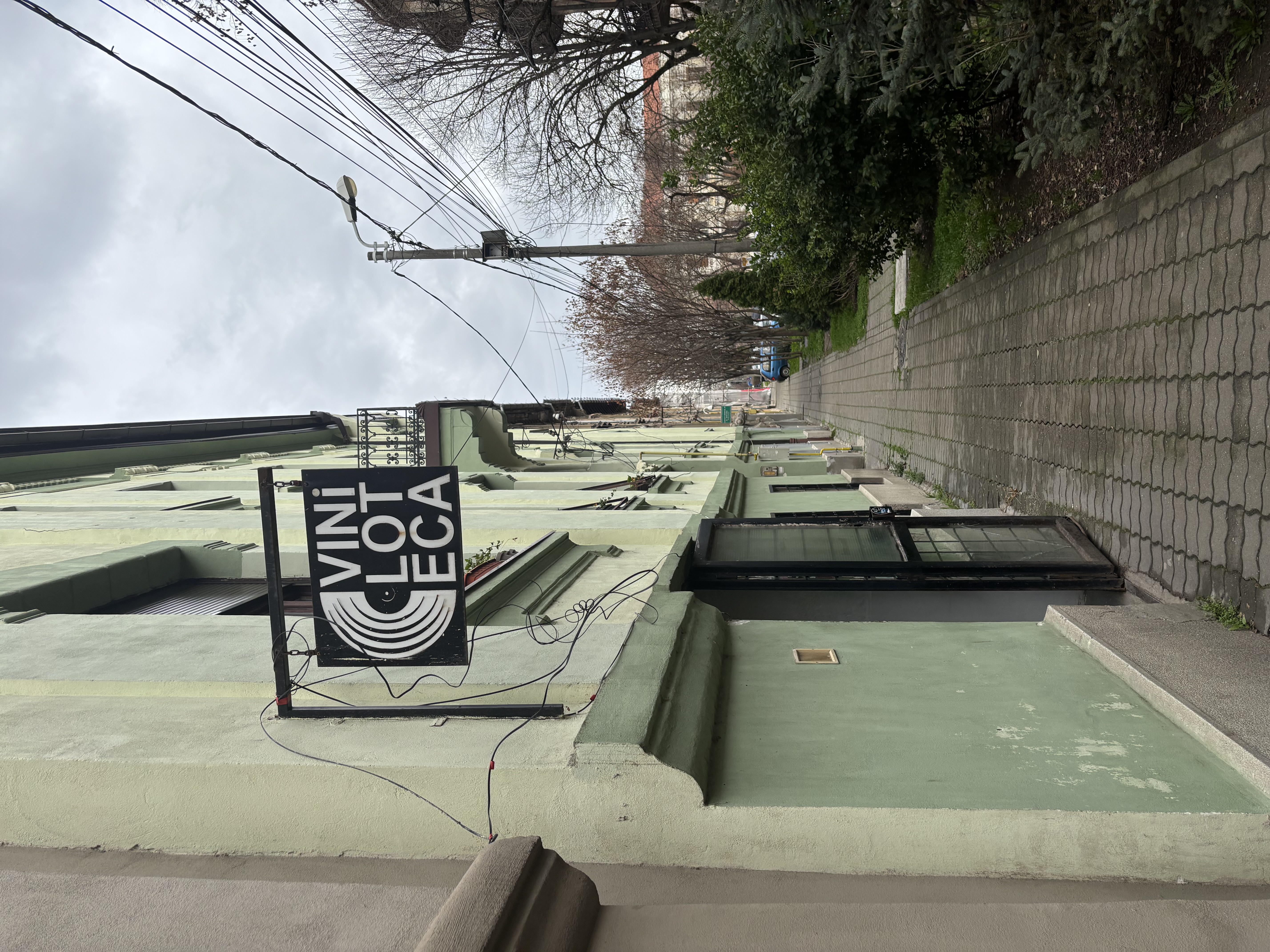
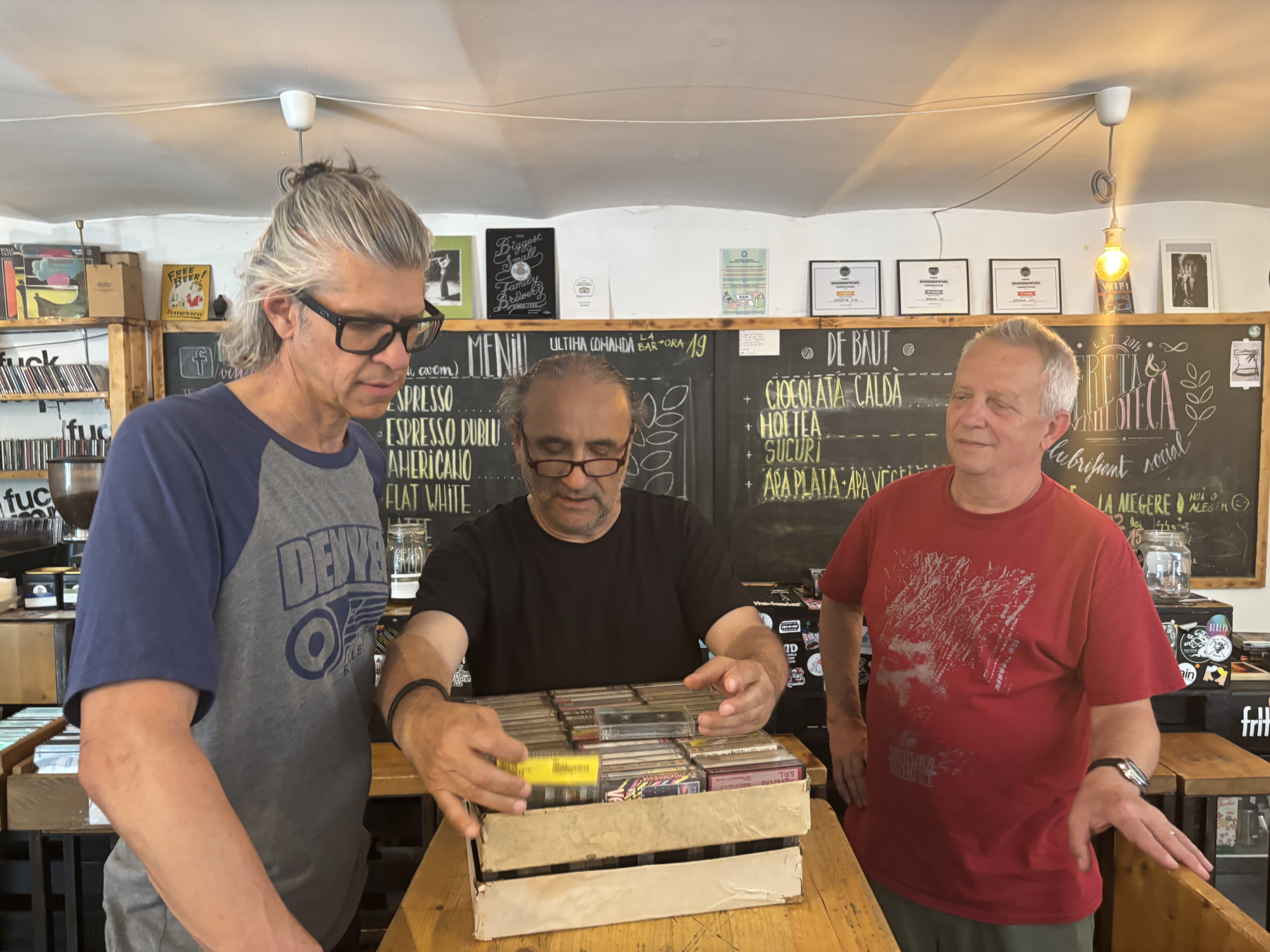
Fretz was led by the guide to Viniloteca, a vinyl shop owned by Emil Biebel. The shop lies in Piața Maria, the starting point of the Romanian Revolution in 1989. Fretz, a bit of a rocker himself, plays the guitar and grew up loving rock and roll. He instantly connected with the owner, Biebel.
“I would just go to Viniloteca pretty much every morning for coffee and then stop for a beer on the way back home,” said Fretz. “We just talked about rock and roll and politics, and then when he started telling me about what it was like living there in the 70s and the 80s, I got really interested as a cultural historian.”
The city of Timișoara pushes up to the borders of Hungary and the then-country of Yugoslavia, which both had more access to cultural imports of the West. Biebel described to Fretz how he smuggled in rock and roll records, and spoke of the underground music scene that dominated the subcultures of the youth in the 70s and 80s. These friendly discussions evolved for Fretz into a question: Did rock and roll play a part in the revolution in Romania?
After the fall of the Berlin Wall on Nov. 9, 1989, the wave of political revolutions moved southward. By late December of that year, rumblings in Romania were reaching their peak. Alongside vinyl, revolutionary literature and ideas were smuggled into the city.
“It wasn't just rock and roll: They were reading Camus, they were reading Orwell, they were reading Sartre. But again, all of these books were smuggled in too,” said Fretz.
On Dec. 16, people gathered outside of the parish of the pastor László Tőkés, who was under threat of expulsion for criticizing the political regime of Nicolae Ceaușescu, protecting and protesting his expulsion. By Dec. 17, the streets were filled with protesters, and the military was deployed in an attempt to quell the rebellion.
Word spread quickly of the lethal force exerted on the protesters throughout the country and by Dec. 24, the whole of the country erupted in rebellion, and Nicolae Ceaușescu and his wife fled the country, where they were executed.
Fast forward 30 years; the remnants of the revolution still linger throughout Timișoara. Fretz’ inquiry into the history and culture of rock and roll in the city triggered his return to Romania in 2025 – nearly 10 years later – for a second Fulbright scholarship. As Fretz delved into his own research about the region, he noticed the lack of documentation of the rock and roll music scene. He set out to Timișoara with the intention of writing a book about the cultural revolution of the 70s and 80s.
Fretz reconnected with Biebel again in person alongside other individuals who were ingrained in countercultural and revolutionary movements in Timișoara. But through these conversations, Fretz realized something:
“Six weeks into interviewing, I realized that this was not a novel; it was a film. The people I was talking to were so engaging and so charismatic.” Fretz continued, “I knew there was absolutely no way I could convey that through the printed word.”
Fretz jumped headfirst into the filming process, using just his phone and cheap lavalier mics to capture the stories of the individuals who lived through the revolution. He collected historical photos and recordings of music from the time period, weaving an audiovisual narrative.
As the film developed, Fretz decided to both host a screening at Regis University as well as submit the documentary to the Ceau Cinema Festival, which celebrates film from around the region, taking place in Timișoara. On Friday, July 17, 2026, around 300 guests filled the largest theater of the festival to view the completed documentary, “The Vinyl Revolution.”
“It was a pretty emotional experience for me because the people in this documentary are my friends,” said Fretz. “Giving them an opportunity to tell their story like that was the most important thing I've ever done in my 30-year academic career.”
The film, according to Fretz, received an overwhelmingly positive reaction, leading into an hour-long discussion following the screening session with him and those featured in the film. Fretz described how he has “received so many emails and Facebook posts afterwards about what the film meant, because it was the viewer’s youth we were able to capture in the film.”
Although the documentary is now complete, it has only begun its life cycle as an educational tool. During his Fulbright scholarship at the University of the West, Fretz noticed that young adults were unaware of the full extent and impact of the Romanian Revolution. The interwoven sociopolitical culture of the time period has not been lost but buried through time. Uncovering the history, people and politics of a Romania in the 1970s and 1980s led Fretz to not only aspire to share this with the young people of Romania, but with an unacquainted American audience.
“Given the state of our political culture right now, when I talked to people about the kind of political repression and totalitarianism that they were living under in the 1980s, it resonated with me as an American in 2026,” said Fretz. “I wanted to tell their story as a way to shed light on the America that we live in right now.”
To learn more about “The Vinyl Revolution,” visit: https://www.thevinylrevolution.com