Regis Life
Sharing Bagels Leads to a New Interdisciplinary Research Lab
In the summer of 2024, while sharing a meal of bagels, Criminology, Sociology and Justice Studies Professor Katie Rogers, Ph.D., and Psychology and Neuroscience Professor Julie Sriken, Ph.D., began discussing pop culture. Their conversation turned to social media posts they’d seen discussing the recent accusations of intimate partner violence against music mogul Sean “Diddy” Combs. As they realized that these discussions reflected social constructions of race, gender, sexuality and crime — common research interests of theirs — the duo decided to collaborate on a research study.
That summer, they began their collaboration. By the fall of 2025, they teamed up with students in Criminology, Psychology, Neuroscience and Sociology and Justice Studies. With such a wide range of perspectives represented, this new lab dubbed itself the Interdisciplinary Qualitative Research Lab (IQRL). The IQRL developed as a collaborative space for students and faculty on campus, designed to foster engagement and training in qualitative research methods.
Unlike quantitative research, which measures social life primarily in numbers and conducts analysis using statistics, qualitative research involves collecting and analyzing non-numerical data through in-depth interviews, focus groups, field observations and analysis of existing media, text and image content. The goal is to understand how and why people think, feel and act the way they do and how their personal lives relate to their broader social worlds.
The IQRL offers Regis students valuable, marketable training in qualitative research methods. Students get hands-on experience with data collection and analysis, including project design, literature review, data cleaning, coding and presentation of findings. All students complete research ethics, compliance and safety training. Students in IQRL also have opportunities to collaborate directly with faculty and present research at academic conferences. Every week, the lab meets to strategize ongoing research, set agendas for future projects and progress plans to submit and present research at academic conferences and symposiums. Since opening its doors in 2025, the lab has involved a rotating membership of eight to eleven undergraduate student members.
“We would really like students to analyze social problems from multiple perspectives and disciplines,” said Sriken. “A core belief for this lab is that using an interdisciplinary approach to research can lead to greater understanding and stronger solutions. Most of all, we hope that Regis students come to see themselves and their lived experiences as contributing valuable insights to research inquiry.”
So far, the lab has focused on investigating inequalities tied to the U.S. criminal system. Research topics have ranged from how constructions of sexuality and deviance influence discussions of criminal trials to gendered racism in ICE recruitment ads to exploring how young adults construct the meaning of “toxic relationships.” Evie Lenox, a junior who is double majoring in Psychology and Peace and Justice Studies, will represent the lab in Chicago this November when she presents research at the American Society of Criminology conference. There, she will share her team’s new findings from an analysis of 484 online Reddit posts discussing the 2025 trial of Sean “Diddy” Combs.
Findings are part of a broader project investigating how people make sense of sexuality, victimization and intimate partner violence through social-media discourse on criminal trials. Students Grace Vigil and Nalleli Flores Robles presented earlier findings from that study at the Western Society of Criminology conference in Denver in Feb. 2026. Findings indicated that, while some online commenters expressed sympathy or understanding for victims involved in the Diddy case, many others repeated myths of “ideal victims” to discredit certain victims deemed unworthy of trust, care or state protection.
As the lab’s directors and principal investigators, Rogers and Sriken offer a combined wealth of research experience and expertise to Regis students. They are also driven by a shared conviction rooted in feminist research methods — that transforming society for the better requires understanding the standpoints and lived experiences of its people. Their own research projects reflect that principle: Rogers investigates how race and gender inequality shape women’s economic opportunities in the cannabis industry and experiences with criminal-legal systems, while Sriken explores how people construct the meaning of intimate partner violence and seek help for the violence in their own lives. Aligned with Regis’ mission to build a more just and humane world, their mission with IQRL is to foster that same kind of transformative, qualitative research among students and faculty across disciplines on the Regis University campus.
“Our goal moving forward is to strengthen our lab’s partnerships with other organizations on campus,” said Rogers. “Regis students are already engaged in fantastic research through the Peaks Co-Lab, the Honors Program and the Undergraduate Research Certificate. Collaborating across campus will help us offer opportunities and support to as many interested students as possible.”
As IQRL started over a meal, the power of breaking bread is not lost on the lab’s principal investigators. Gathering for a meal offers the lab valuable time to build skills and reflect on possible new research lines. “We will get together with the lab over coffee and snacks to learn how to facilitate focus groups,” said Sriken. “It’s a great way to have fun while practicing our qualitative interviewing skills.”
“We’re thinking of getting together for a pizza party at the end of the semester, too, just to celebrate our hard work,” said Rogers. “Who knows what new projects will come from these meals?”
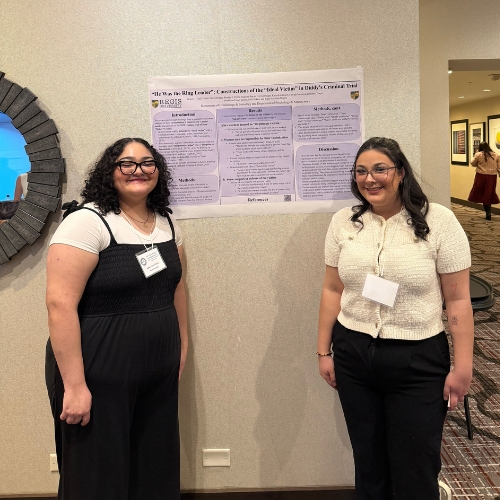
Students Nalleli Flores Robles (left) and Grace Vigil (right) at the Western Society of Criminology conference in Denver in Feb. 2026.