
FastForward Programs at Regis University
Earn a bachelor's and an advanced degree (such as a master’s or doctorate) faster through Regis University's FastForward Program. Our accelerated pathways and dual degree combinations save you both time and money, giving you a head start over your peers and the advanced credentials needed to excel in your career.
Jump to: Apply | Business and Computing | FAQs | Getting Started | Health Care | Liberal Arts and Humanities | Science

Save Time
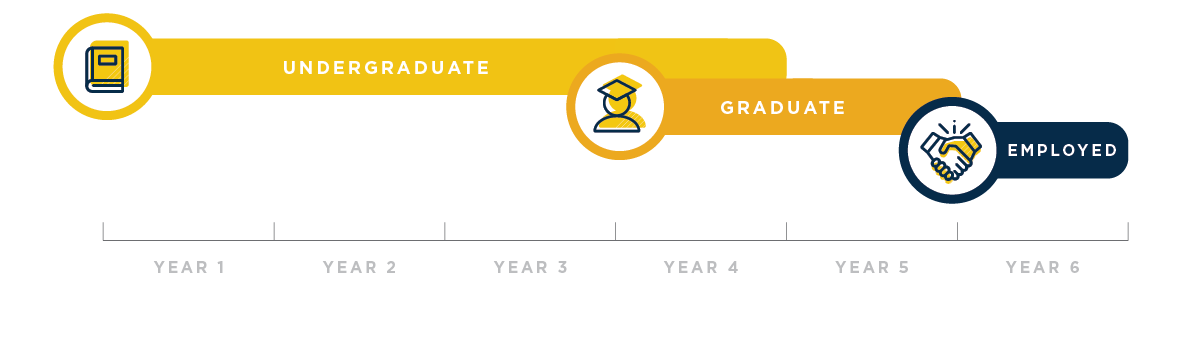
Earn both a bachelor’s and advanced degree in as little as five years.

Save Money*
Up to four classes can count toward both undergraduate and graduate requirements.

Get to Work
Get out of the classroom and get a head start in the workforce.
How It Works
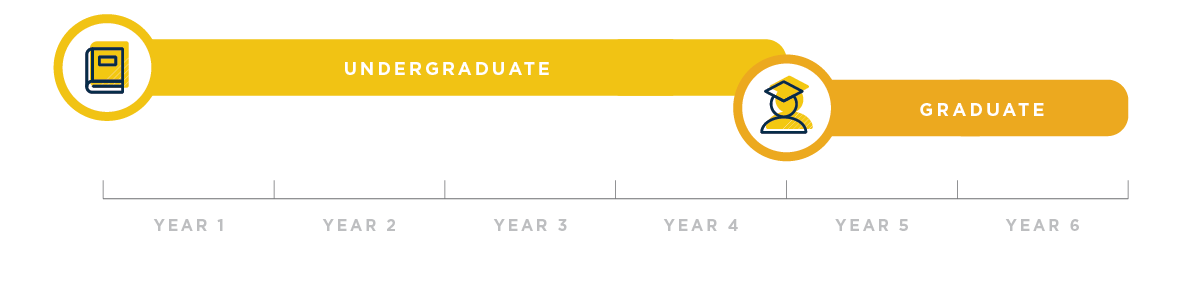
Instead of completing your undergraduate program before starting an advanced degree, our FastForward pathways allow you to get a head start on your graduate or doctoral education. Whether you are pursuing a master’s degree or a doctoral pathway (such as an OTD, DNP or Pharm.D. degree), these combinations allow you to overlap your learning.
Once you reach the required standing (typically junior year or 60+ credit hours in good academic standing), you'll be eligible to enroll in advanced courses that count toward both your undergraduate and future professional requirements. There's no up-front commitment when you start your bachelor's program at Regis, so you don't have to decide right away — simply talk to your academic advisor if you think an advanced credential is in your future.
Traditional Degree Progression
FastForward Degree Progression
Qualifying Program Combinations

Business and Computing
| The following undergraduate degrees: | → | Can be combined with the following graduate degrees: |
| BSBA Accounting Major | M.S. Accounting | |
| BSBA Accounting Major (Accelerated) | M.S. Information Systems | |
| M.S. Applied Artificial Intelligence |
| B.S. Business Administration | → | M.S. Information and Cyber Security |
| B.S. Business Administration (Accelerated) | M.S. Organizational Leadership | |
| M.S. Applied Artificial Intelligence |
| B.S. Computer Science | → | M.S. Information and Cyber Security |
| B.S. Computer Science (Accelerated) | M.S. Data Science | |
| M.S. Applied Artificial Intelligence |
| BSBA Marketing Major | → | M.S. Data Science |
| BSBA Finance Major |

Health Care
| The following undergraduate degrees: | → | Can be combined with the following advanced (master's or doctoral) degrees: |
| BSBA Health Care Administration Major | M.S. Health Services Administration | |
| BSBA Health Care Administration Major (Accelerated) | Project Leadership and Management M.B.A. | |
| M.S. Organizational Leadership |
Pre-professional Pathways
| Pre-Occupational Therapy | → | Doctor of Occupational Therapy (3+3 OTD) |
| Pre-Physical Therapy | → | Doctor of Physical Therapy (DPT) |
| Pre-Pharmacy | → | Doctor of Pharmacy (Pharm.D.) |
| 0-5 Early Assurance | ||
| Pharm Foundations | ||
| PharmTech to Pharm.D. |
| B.S. Nursing | → | Post-BSN to DNP (Doctor of Nursing Practice) |
| Accelerated BSN |

Science
| The following undergraduate degrees: | → | Can be combined with the following graduate degree: |
| B.S. Biology | M.S. Environmental Biology | |
| B.S. Environmental Science |

Liberal Arts and Humanities
| The following undergraduate degrees: | → | Can be combined with the following graduate degree: |
| Any Bachelor of Arts Program | Master of Fine Arts (MFA) in Creative Writing | |
| Bachelor of Fine Arts (BFA) in Creative Writing |
| The following undergraduate degrees: | → | Can be combined with the following graduate degree: |
| Any Liberal Arts and Sciences Program | Master of Nonprofit Management Master of Sustainable Development Practice |
| The following undergraduate degrees: | → | Can be combined with the following graduate degree: |
| Bachelor of Applied Science with Management specialization |
M.S. Organizational Leadership |
| The following undergraduate degrees: |
→ |
Can be combined with the following graduate degrees: |
| B.A. Communication | ||
| B.A. Criminology | M.S. Criminology | |
| Bachelor of Applied Science | ||
| B.A. Liberal Arts | ||
| B.A. Social Science | ||
| B.A. Sociology and Justice Studies |
How to Get Started
Step 0: Get Admitted to Regis
Before you can bridge your undergraduate studies into an advanced degree, you must first be admitted to an undergraduate degree program. Whether you are a first-year student or a transfer, you can start your application or contact the Office of Admissions to learn more about the pathways available for your major.
Step 1: Partner With Your Academic Advisor
As a current student, if you're interested in an accelerated or dual-degree pathway, contact your academic advisor. They will work with you one-on-one to create a customized degree track and ensure you are meeting the specific prerequisites for your chosen advanced program.
Students interested in pre-professional health tracks (like OTD, PT or Pharmacy) or nursing pathways should connect with an advisor as early as possible to plan their clinical requirements.
Step 2: Register for Advanced Courses
Once you reach the required standing (typically 60 or more credit hours), you'll be eligible to enroll in graduate-level classes. These courses are usually taken during your final undergraduate years and "double-count" toward both your bachelor's and your advanced degree (master’s or doctorate). This overlap is what allows you to reduce your total time in school and jumpstart your professional career.
Step 3: Seamlessly Transition to Your Advanced Degree
After completing your undergraduate requirements, you will move directly into the remaining portion of your advanced degree program. In most FastForward pathways, you are automatically admitted† to the graduate or doctoral portion without needing to submit a separate application or additional materials, ensuring a smooth transition into your professional studies.
FastForward FAQs
That's okay! The FastForward program requires no commitment or additional costs — you have until your junior year to decide whether or not you would like to continue on to complete a advanced degree. There's no special application process or admissions materials.
However, if you do think a FastForward program would be right for you, we recommend talking to your academic advisor or admissions counselor as early as possible. This way we can be sure you take the right classes at the right time.
While enrolled in your undergraduate degree, you will be charged the per-semester undergraduate tuition rate. Master’s or doctorate-level classes taken during your undergraduate degree are included in this rate.
Once you have completed your undergraduate degree and are enrolled in your advanced degree program, tuition will be charged based on the per-credit-hour rate associated with your specific postgraduate program.
We typically require upper-level classes for an advanced degree to be completed at Regis. If you have any college credit that you think may apply to your undergraduate program, be sure to let your admissions counselor know during the undergraduate admissions process. Check out our AP, IB and College Credit page to see what may qualify.
Any credits taken as part of the undergraduate portion of the FastForward program will still count towards your undergraduate degree. If during this time you decide a master's or doctoral degree isn't for you, you'll still graduate with a bachelor's degree without having to re-take any courses.
*Average cost savings is calculated based on the average reduction in credit hours required to complete a graduate degree multiplied by the average per-credit-hour tuition rate of qualified graduate degree programs. Actual cost savings will vary based on program selection.
†Automatic admission is granted pending satisfactory academic progress and good standing throughout your undergraduate program.